October 31, 2015
This latest project of Artist Playground is a very unique one. It is a one-woman show entitled "Audire (Listen Carefully)". I purposely did not read any advanced information about it because I wanted to be surprised. It turned out though, that maybe I should have read some background about it. I would have been able to appreciate the project more.
The show opened in total darkness. Four ladies in black came out shaking boxes. When they reached the stage, they placed various items (like toys, accessories, household items, etc...) on the floor upstage. (They would give her different props in each of her four segments in this show.) Enter Ms. Angelina Kanapi in a white dress. She began playing around with the stool and the other things there on the stage. Her unusual choice of words seemingly meant nothing, a flight of ad-libbed ideas. Her strange gestures and facial expressions all seemed as random as her props.
That first segment was very bizarre. There were a lot of incomplete words and phrases. I do not remember much of it. The second segment, we see Ms. Kanapi strumming chairs like a guitar. I felt she meant to act like a drugged out rock star. Finally, after singing what sounded like a Nirvana song, she collapse and convulsed on the floor, then lights out. The third segment, we see Ms. Kanapi tie her hair into to pigtails and begin talking like a bratty child to her yaya. She began jumping up and down as a tot in a tantrum shouting words so foul they sounded so funny. The fourth segment, we see Ms. Kanapi in an sultry and earthy mood. This final part felt like a frank excerpt from the "Vagina Monologues".
Then it was over. I am not going to pretend I totally got what just transpired in the last hour. After the curtain call, Ms. Kanapi thanked the staff who helped her with the show. She was joined on the stage by the artistic director of Artist Playground Roeder Camanag, on behalf of show director Jeffrey Camanag who was sick today. They engaged the audience in a post-show discussion about the performance. In most shows, the play proper was enough to speak for itself. For this particular experimental type of production, this Q&A session was a most essential part to grasp the whole meaning of the show and its very special concept.
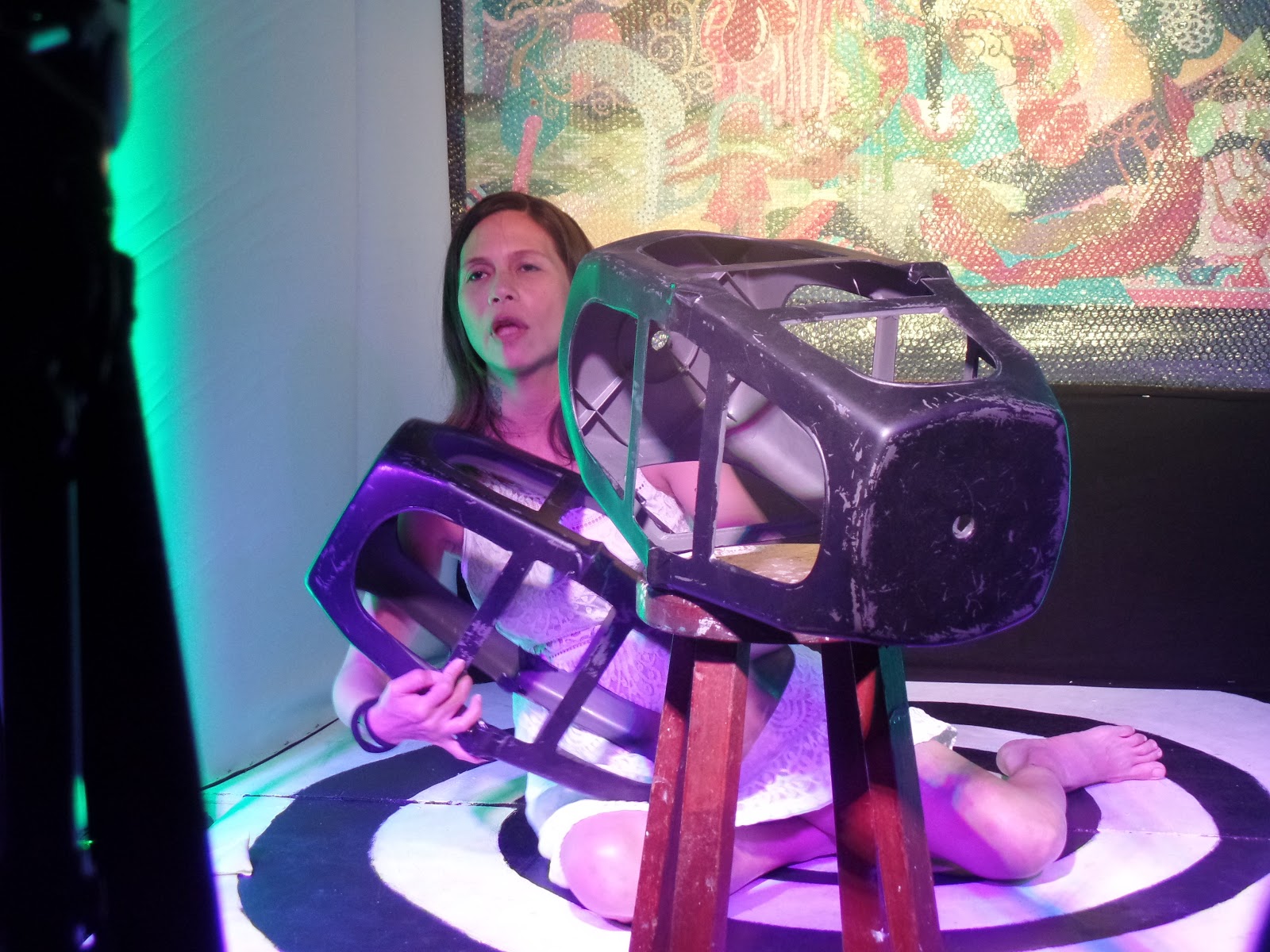
It was only a post-show realization for me that Ms. Kanapi totally improvised everything she was doing based on the sounds (music, sound effects, noises, whispers, moans, silence) she heard. This meant that the whole show was actually extemporaneous on Ms. Kanapi's part based on the totally random sounds given her by the sound technician. Every show then will be not be the same as the one before. I did not spoil anything for you by telling you what happened in the show I watched. You will see a totally different one every time. This was an eye-opening revelation that made me see the whole performance in a whole new light. This show was not a case of the schizophrenic emperor's new clothes.
So that is what the title meant. Ms. Kanapi should listen carefully to the soundtrack to react to and spontaneously perform. The audience should listen carefully to the soundtrack to understand where Ms. Kanapi and her various strange antics were coming from.
It was a delight to see Ms. Kanapi performing live.This prime collaboration with the sound man is a pet concept that had been playing in her mind, only to find fruition now thanks to the exploratory thrust of Artist Playground. I knew Ms. Kanapi from her most unusual and quirky roles in indie films I've seen, like "Hustisya" (My Review) with Nora Aunor, a couple Lav Diaz opuses namely "Norte: Hangganan ng Kasaysayan" (My Review) and "Mula Sa Kung Ano ang Noon" (My Review), and just this week "Matangtubig" (My Review). I cannot think of another actress with such a wacky, unconventional yet intuitive soul who can pull this daring type of performance art off.
************
If you want to experience this different type of theater, you can catch the last few shows of "Audire". There is one show on November 4, 2015 at 7pm, then three shows on November 7, 2015 at 3, 5, and 7pm. Tickets at P250. Students only pay P200. Venue of the show is The Little Room Upstairs, Rm. 1701 Landsdale Tower, Mother Ignacia Ave. Quezon City. Look up Ms. Roj Regoso on Facebook for inquiries and reservations.
Saturday, October 31, 2015
Saturday, October 24, 2015
Review of Dulaang UP's HARING LEAR: Campy and Colorful
October 24, 2015
Afraid that his end is near, King Lear decided to divide his kingdom among his three daughters. The elder two, Goneril and Regan, praise him to high heavens, and they got to divide the kingdom between them. The youngest Cordelia was more reserved with her answer, which disappointed the king no end, resulting in her banishment from the kingdom. Not long after, the true evil natures of Goneril and Regan show and they banish the king himself into the wilderness. The king goes mad with extreme grief.
"King Lear" as written by William Shakespeare is a very complex tragedy. Not only do we see the drama between Lear and his daughters, but there are several subplots woven around this main story. The daughters also have their respective husbands with their own political ambitions. There was also another brewing drama about a family close to the king -- the Duke of Gloucester and his two sons, the loyal legitimate son Edgardo and the power-hungry illegitimate one Edmundo.
For this Dulaang UP version I watched, the new Filipino translation was by Nicolas Pichay, which was adapted and directed by Tony Mabesa. To set it apart from other local stagings of this same play, it was decided to employ a Southeast Asian motif to the set and costumes. The backdrop set pieces by Ohm David were inspired by the temple ruins in Siem Reap, Cambodia with its gnarled giant banyan roots. The colorful costumes by Eric Pineda were mostly Thai in design, with elements of Chinese and Balinese in others. The overall effect of the language, set and costumes was very striking, although a disconnect can be felt when the place names mentioned remain to be British, like Kent, Cornwall or Dover.
Film director Joel Lamangan takes on the role of King Lear in this Filipino version. Lamangan played Lear in such a open and light manner that it was easy for audiences to connect with him and his character's plight. This kind of over-the-top acting style and melodramatic line deliveries became appropriate though when seen in the light of Lear's eventual madness. Albeit uneven and hammy, the deterioration of Lear's dignity and mental stability was very well-conveyed this way.
Because she is quite petite, I was surprised when it was Martha Comia who played the eldest daughter Goneril. Comia always plays a vixen in her various UP roles and her Goneril was another one. While this one was truly contemptible, the way Comia played her was still such a delight to watch. Astarte Abraham I first saw as Madre de Dios in "Kung Paano Ako Naging Leading Lady" earlier this year. As she played the equally hateful Regan this time (and she was very good at it, mind you, with her very expressive face), I was worried about how all the shouting she needed to do for this role may affect her amazing singing voice. Chesca Ostrea was a very pretty, fresh-faced Cordelia, but she was still stumbling with her lines despite this being the last weekend of the show's run.
The best overall performance for me for the whole show was given by Jojo Cayabyab as the Earl of Gloucester. This actor was consistently tops in his intense delivery of lines, in true Shakespearean style. He never went out of character even once from beginning to end. His best scene were those during and after when certain injuries were inflicted to his face. The technique of how the production achieved the effect of this scene was stunning.
Edmundo was played by Brian Sy. Sy clearly played this villainous and amorous role with relish. He possesses the duplicitous charm required to make this role convincing. He even shocked the audience with a kissing scene with an unexpected partner. Edgardo was played by Carlo Tarobal. This role was done so awkwardly, especially in those scenes when Edgardo pretended to be the madman Tomas. Of course, the role is attention-grabbing no doubt, but I only found it all very awkward. Tarobal's difficulty in drawing out his sword drew giggles in what should have been dramatic moments.
I could not help comparing this production with the one by PETA staged 2012, just three years ago. The Filipino translation staged then was by Bienvenido Lumbera and the show was directed by Nonon Padilla. That version with an all-bald, all-black, all-male cast was much darker, more intense and very serious. It also had a real thunderstorm with water right there on the stage! (My review of that show was posted HERE.)
However, this DUP production had its own charm by being the naughtily campier and more vibrantly colorful version. Fresh from the innovative postmodern take on "Romeo and Juliet" in their last show "R </3 J", with this production of "Haring Lear" in Filipino, DUP created yet another fresh and entertaining interpretation of a classic Shakespearean tragedy.
True to DUP tradition, there is a parallel English version of "King Lear" in straight Shakespeare. This one stars Leo Rialp as King Lear, with Frances Makil-Ignacio, Jeremy Domingo, Guelan Luarca among others in the alternate cast. That promises to be a totally different viewing experience from this Filipino version.
****************
"King Lear" opened last October 7, 2015. It will have two last shows on October 25, 2015. The 10 am show will be the Filipino version, and the final show at 3pm will be the English version. Show runs at the Wilfrido Ma. Guerrero Theater. In celebration of DUP's 40th anniversary this year, they had a slideshow showing notable actors who had performed with DUP over its past 40 years. That slideshow alone is an interesting must-see for theater fans.
Afraid that his end is near, King Lear decided to divide his kingdom among his three daughters. The elder two, Goneril and Regan, praise him to high heavens, and they got to divide the kingdom between them. The youngest Cordelia was more reserved with her answer, which disappointed the king no end, resulting in her banishment from the kingdom. Not long after, the true evil natures of Goneril and Regan show and they banish the king himself into the wilderness. The king goes mad with extreme grief.
"King Lear" as written by William Shakespeare is a very complex tragedy. Not only do we see the drama between Lear and his daughters, but there are several subplots woven around this main story. The daughters also have their respective husbands with their own political ambitions. There was also another brewing drama about a family close to the king -- the Duke of Gloucester and his two sons, the loyal legitimate son Edgardo and the power-hungry illegitimate one Edmundo.
For this Dulaang UP version I watched, the new Filipino translation was by Nicolas Pichay, which was adapted and directed by Tony Mabesa. To set it apart from other local stagings of this same play, it was decided to employ a Southeast Asian motif to the set and costumes. The backdrop set pieces by Ohm David were inspired by the temple ruins in Siem Reap, Cambodia with its gnarled giant banyan roots. The colorful costumes by Eric Pineda were mostly Thai in design, with elements of Chinese and Balinese in others. The overall effect of the language, set and costumes was very striking, although a disconnect can be felt when the place names mentioned remain to be British, like Kent, Cornwall or Dover.
Film director Joel Lamangan takes on the role of King Lear in this Filipino version. Lamangan played Lear in such a open and light manner that it was easy for audiences to connect with him and his character's plight. This kind of over-the-top acting style and melodramatic line deliveries became appropriate though when seen in the light of Lear's eventual madness. Albeit uneven and hammy, the deterioration of Lear's dignity and mental stability was very well-conveyed this way.
Because she is quite petite, I was surprised when it was Martha Comia who played the eldest daughter Goneril. Comia always plays a vixen in her various UP roles and her Goneril was another one. While this one was truly contemptible, the way Comia played her was still such a delight to watch. Astarte Abraham I first saw as Madre de Dios in "Kung Paano Ako Naging Leading Lady" earlier this year. As she played the equally hateful Regan this time (and she was very good at it, mind you, with her very expressive face), I was worried about how all the shouting she needed to do for this role may affect her amazing singing voice. Chesca Ostrea was a very pretty, fresh-faced Cordelia, but she was still stumbling with her lines despite this being the last weekend of the show's run.
The best overall performance for me for the whole show was given by Jojo Cayabyab as the Earl of Gloucester. This actor was consistently tops in his intense delivery of lines, in true Shakespearean style. He never went out of character even once from beginning to end. His best scene were those during and after when certain injuries were inflicted to his face. The technique of how the production achieved the effect of this scene was stunning.
Edmundo was played by Brian Sy. Sy clearly played this villainous and amorous role with relish. He possesses the duplicitous charm required to make this role convincing. He even shocked the audience with a kissing scene with an unexpected partner. Edgardo was played by Carlo Tarobal. This role was done so awkwardly, especially in those scenes when Edgardo pretended to be the madman Tomas. Of course, the role is attention-grabbing no doubt, but I only found it all very awkward. Tarobal's difficulty in drawing out his sword drew giggles in what should have been dramatic moments.
I could not help comparing this production with the one by PETA staged 2012, just three years ago. The Filipino translation staged then was by Bienvenido Lumbera and the show was directed by Nonon Padilla. That version with an all-bald, all-black, all-male cast was much darker, more intense and very serious. It also had a real thunderstorm with water right there on the stage! (My review of that show was posted HERE.)
However, this DUP production had its own charm by being the naughtily campier and more vibrantly colorful version. Fresh from the innovative postmodern take on "Romeo and Juliet" in their last show "R </3 J", with this production of "Haring Lear" in Filipino, DUP created yet another fresh and entertaining interpretation of a classic Shakespearean tragedy.
True to DUP tradition, there is a parallel English version of "King Lear" in straight Shakespeare. This one stars Leo Rialp as King Lear, with Frances Makil-Ignacio, Jeremy Domingo, Guelan Luarca among others in the alternate cast. That promises to be a totally different viewing experience from this Filipino version.
****************
"King Lear" opened last October 7, 2015. It will have two last shows on October 25, 2015. The 10 am show will be the Filipino version, and the final show at 3pm will be the English version. Show runs at the Wilfrido Ma. Guerrero Theater. In celebration of DUP's 40th anniversary this year, they had a slideshow showing notable actors who had performed with DUP over its past 40 years. That slideshow alone is an interesting must-see for theater fans.
Saturday, October 17, 2015
Review of TP's MGA BUHAY NA APOY: Folklore, Fabrications and Family
October 17, 2015
"Mga Buhay na Apoy" just won the First Prize for a Full Length Play in the 2015 Carlos Palanca Awards for Literature for playwright/director Auraeus Solito. Since 2013, Mr. Solito went by the spirit-tribal name of Kanakan-Balintagos (Hunter of Truth). "Buhay" is a play he wrote back in 1994, but the manuscript got misplaced, only to resurface 20 years later.
His most famous movie would be his first feature film "The Blossoming of Maximo Oliveros", a winner of several international awards. His latest film was "Esprit de Corps" which won him the Best Director Award in last year's Cinema One Originals Film Festival. "Esprit" is an adaptation of the first play he ever wrote at the age of 17. After watching "Buhay," I think it may just follow in the footsteps of "Esprit" and get a film version of its own.
Leda Santos was very excited that her estranged daughter Aurora Alba was moving back home. To welcome her back, Leda hosted a family get-together in their spacious garden at their mansion in Sampaloc. Invited are Leda's sisters, Lili and Selmah, and their respective families. Leda's artist son Aran was also happy that his sister is coming home, but he was constantly at odds with his mother, even during the party itself. The deeper the night got and the conversations got more intense, long-repressed family secrets all come spilling out, threatening to rip the broken family further apart.
It is clearly seen from the script that Kanakan-Balintagos loves his home province of Palawan. This play not only boasts of Palawan's rich flora and fauna, we also get a profound glimpse into its rich folkloric and cultural legacy. Leda and her sisters were originally from a remote island in Palawan. Lili and apparently even Leda herself were shaman priestesses back then, probably inspired by the author's own uncle who was a shaman. The show opens with haunting Palawanon chants sung with the powerful voice of Carol Bello. We will also see a Palawan diwata lurking around their garden, played by Lhorvie Nuevo.
Irma Adlawan is a respected award-winning actress of film and television. However, this is the first time I was going to see her act live on stage in the lead role of Leda, which is one big reason why I really wanted to catch this play. For the most part of the play, we only hear people talk about Leda, a mother who cannot seem to get close with her children. But It is only in the second half of the climactic and critical Act 3 that we see the full dramatic power that Ms. Adlawan is known for.
The quiet and mysterious elder sister Lili was played by Carol Bello. Her chanting is truly unforgettable. Her much younger husband Benj was played by TP stalwart Jonathan Tadioan, who was as natural as he always was onstage.
The hearty and jolly younger sister Selmah was played by Malou Crisologo, who is a familiar face on TV. Crisologo was a shining bright light on the constant dark scenario playing onstage. 13-year old Kyrie Samodio played Selmah's daughter Topaz, curious and wise for her years. JV Ibesate plays her boyfriend Ringgo in an oddly childish portrayal.
Veteran actress Peewee O'Hara and another TP regular Doray Dayao play the domestic helpers Yaya Naty and Aling Gusing.
Karen Gaerlan effectively played her troubled character Aurora Alba, who turned out to be the voice of reason in the play. On the other hand, Russell Legaspi seemed to be having a harder time connecting to his troubled character of Aran. As the only male major character, Legaspi's acting was rather tentative amidst the powerful portrayal of the ladies. This felt as uncomfortable as the braids on his head. It was not easy to connect with his character.
The stage design by noted landscape architect Paulo Alcazaren, who had to build a garden with a huge tree as the centerpiece right there on the stage of the Little Theater. The emotive lighting design was by the multi-talented Dennis Marasigan, whom I only knew before as actor, director and writer.
The entire first two acts were but an extended introduction to the main meat of the play in the explosive Act 3. In fact, Act 3 alone is already worth the price of admission for the impressive flow of the dialogue and the array of fine acting on display. Kanakan-Balintagos has written and told an intricate story about how a life full of pain, heartache and suffering in one person affected the life of every person in her immediate family, mixed in with Palawan folklore. This is an uncommonly powerful piece of Filipino theater with distinct ethnic pride. Kudos!
*********
"Mga Buhay na Apoy" opened last October 2 and will run weekends up to October 25, 2015 at the Little Theater of the Cultural Center of the Philippines. Remaining shows on October 18, 23, 24 and 25, 2015, with 8pm shows on Fridays and Saturdays and 3pm matinee shows on Saturdays and Sundays. For tickets, call TicketWorld: 891.9999 | CCP Box Office: 832.3704 or Tanghalang Pilipino: 0917-8763678 | 0908-8941384.
"Mga Buhay na Apoy" just won the First Prize for a Full Length Play in the 2015 Carlos Palanca Awards for Literature for playwright/director Auraeus Solito. Since 2013, Mr. Solito went by the spirit-tribal name of Kanakan-Balintagos (Hunter of Truth). "Buhay" is a play he wrote back in 1994, but the manuscript got misplaced, only to resurface 20 years later.
His most famous movie would be his first feature film "The Blossoming of Maximo Oliveros", a winner of several international awards. His latest film was "Esprit de Corps" which won him the Best Director Award in last year's Cinema One Originals Film Festival. "Esprit" is an adaptation of the first play he ever wrote at the age of 17. After watching "Buhay," I think it may just follow in the footsteps of "Esprit" and get a film version of its own.
Irma Adlawan and Malou Crisologo
Leda Santos was very excited that her estranged daughter Aurora Alba was moving back home. To welcome her back, Leda hosted a family get-together in their spacious garden at their mansion in Sampaloc. Invited are Leda's sisters, Lili and Selmah, and their respective families. Leda's artist son Aran was also happy that his sister is coming home, but he was constantly at odds with his mother, even during the party itself. The deeper the night got and the conversations got more intense, long-repressed family secrets all come spilling out, threatening to rip the broken family further apart.
Carol Bello and Lhorvie Nuevo
It is clearly seen from the script that Kanakan-Balintagos loves his home province of Palawan. This play not only boasts of Palawan's rich flora and fauna, we also get a profound glimpse into its rich folkloric and cultural legacy. Leda and her sisters were originally from a remote island in Palawan. Lili and apparently even Leda herself were shaman priestesses back then, probably inspired by the author's own uncle who was a shaman. The show opens with haunting Palawanon chants sung with the powerful voice of Carol Bello. We will also see a Palawan diwata lurking around their garden, played by Lhorvie Nuevo.
Irma Adlawan is a respected award-winning actress of film and television. However, this is the first time I was going to see her act live on stage in the lead role of Leda, which is one big reason why I really wanted to catch this play. For the most part of the play, we only hear people talk about Leda, a mother who cannot seem to get close with her children. But It is only in the second half of the climactic and critical Act 3 that we see the full dramatic power that Ms. Adlawan is known for.
Bello, Crisologo, Adlawan, Gaerlan, O'Hara, Legaspi
The quiet and mysterious elder sister Lili was played by Carol Bello. Her chanting is truly unforgettable. Her much younger husband Benj was played by TP stalwart Jonathan Tadioan, who was as natural as he always was onstage.
The hearty and jolly younger sister Selmah was played by Malou Crisologo, who is a familiar face on TV. Crisologo was a shining bright light on the constant dark scenario playing onstage. 13-year old Kyrie Samodio played Selmah's daughter Topaz, curious and wise for her years. JV Ibesate plays her boyfriend Ringgo in an oddly childish portrayal.
Veteran actress Peewee O'Hara and another TP regular Doray Dayao play the domestic helpers Yaya Naty and Aling Gusing.
Karen Guerlan and Russell Legaspi
Karen Gaerlan effectively played her troubled character Aurora Alba, who turned out to be the voice of reason in the play. On the other hand, Russell Legaspi seemed to be having a harder time connecting to his troubled character of Aran. As the only male major character, Legaspi's acting was rather tentative amidst the powerful portrayal of the ladies. This felt as uncomfortable as the braids on his head. It was not easy to connect with his character.
The stage design by noted landscape architect Paulo Alcazaren, who had to build a garden with a huge tree as the centerpiece right there on the stage of the Little Theater. The emotive lighting design was by the multi-talented Dennis Marasigan, whom I only knew before as actor, director and writer.
Traditional Palawan Greeting Gesture at the Curtain Call
The entire first two acts were but an extended introduction to the main meat of the play in the explosive Act 3. In fact, Act 3 alone is already worth the price of admission for the impressive flow of the dialogue and the array of fine acting on display. Kanakan-Balintagos has written and told an intricate story about how a life full of pain, heartache and suffering in one person affected the life of every person in her immediate family, mixed in with Palawan folklore. This is an uncommonly powerful piece of Filipino theater with distinct ethnic pride. Kudos!
*********
"Mga Buhay na Apoy" opened last October 2 and will run weekends up to October 25, 2015 at the Little Theater of the Cultural Center of the Philippines. Remaining shows on October 18, 23, 24 and 25, 2015, with 8pm shows on Fridays and Saturdays and 3pm matinee shows on Saturdays and Sundays. For tickets, call TicketWorld: 891.9999 | CCP Box Office: 832.3704 or Tanghalang Pilipino: 0917-8763678 | 0908-8941384.
Friday, October 16, 2015
Review of Ballet Phils' SARONG BANGGI: Folk Songs and Family Bonds
October 16, 2015
Honestly, I had no idea what "Sarong Banggi" was going to be about when I decided to go watch it. I just knew that Maestro Ryan Cayabyab himself is going to be conducting the Philippine Philharmonic Orchestra, and for me that was enough reason. The orchestra will be playing Filipino folk songs arranged and orchestrated by Mr. Cayabyab to accompany newly-choreographed ballet numbers rendered by the dancers of Ballet Philippines.
The story opens with a lone female dancer in white, who was later joined by a number of dancers in colorful costumes, as if preparing for a party. They carry the girl in white upward and into their midst. When the crowd cleared, the young girl in white had become an older lady in red. This would just be the first among several magical numbers performed tonight.
The lady in red is Pilar, who is celebrating her birthday with her grown-up children and her friends. She is notably lonely and aloof, despite the celebrations going on around her, ostensibly because she is missing her husband Jose, the man in blue. Pilar reminisces on her youth (represented by the girl in white) and how she met the young Jose (represented by the boy in white). She recalled their times together, idyllic and otherwise.
The older Pilar was portrayed by the always-elegant Soloist Rita Angela Winder, while the older Jose is portrayed by no less than Principal Dancer Jean Marc Cordero. Their maturity and dancing skills were unquestionably ideal for these lead roles. Winder, in particular, had a very expressive face. She conveyed her character's loneliness, anguish and longing so well, we can feel her pain, especially in what I felt was her best number "Walay Angay" (choreographed by Nonoy Froilan), which depicted the suffering of wronged women.
For me though, the more memorable dance performances were delivered by the young Pilar and Jose, portrayed by the petite and pretty Junior Soloist Monica Amanda Gana and the dashing and energetic Junior Principal Dancer Earl John Arisola. These two had a very electric chemistry between them. You can already feel it in their first number together, the big "West Side Story"-inspired "Salidumay" (choreographed by Ronelson Yadao). Their passionate pas de deux number "Malinac Lay Labi" (choreographed by Carissa Adea) was most beautifully executed.
Among the familiar folk songs recognized were "Ati Cu Pung Singsing", "Dalagang Pilipina", "Si Felimon", "Usahay", "Sampaguita" and of course the title song "Sarong Banggi" which closes the first act. The spectacularly joyful finale, featuring a garden full of kites flying, was set to the tune of Nonoy Gallardo's modern folk song "Saranggola ni Pepe" (choreographed by Carlo Pacis). The other choreographers involved were Principal Soloist Cyril Aran Fallar (who also played Jose's friend Felimon) and BP Artistic Director Paul Alexander Morales (who also directed this project).
The arrangements of Maestro Cayabyab and the playing of the PPO were of course flawless. Special mention goes to the lady on the xylophone whose crystalline notes were distinctly heard above the rest.
Very remarkable was the striking costume design of Rajo Laurel with his delightful play on colors. Respected theater and film director Dennis Marasigan wrote a simple yet affecting libretto for the story told by the dances. The set design by Ohm David was so picturesque in its deceptive simplicity. Creating an effective visual illusion on huge stage of the CCP Main Theater is by no means an easy task.
Overall, this was a very satisfying, very colorful and entertaining show. The start may be slow, but once you get the drift of the story, you will definitely get drawn in and touched emotionally. You will leave the show with a smile on your face.
***********
"Sarong Banggi" will have a very limited run this weekend only for just four performances. There will be two performances on October 17, 2015, at 2pm and 6pm, and one final performance on October 18, 2015, at 2pm. Ticket prices range from P1,500 to P400, with 50% off for students. Please call (02) 551-1003, email info@ballet.ph, or PM on fb.com/balletphilippines for more info.
Honestly, I had no idea what "Sarong Banggi" was going to be about when I decided to go watch it. I just knew that Maestro Ryan Cayabyab himself is going to be conducting the Philippine Philharmonic Orchestra, and for me that was enough reason. The orchestra will be playing Filipino folk songs arranged and orchestrated by Mr. Cayabyab to accompany newly-choreographed ballet numbers rendered by the dancers of Ballet Philippines.
Maestro and the Orchestra
The story opens with a lone female dancer in white, who was later joined by a number of dancers in colorful costumes, as if preparing for a party. They carry the girl in white upward and into their midst. When the crowd cleared, the young girl in white had become an older lady in red. This would just be the first among several magical numbers performed tonight.
The Set Design of Ohm David
The lady in red is Pilar, who is celebrating her birthday with her grown-up children and her friends. She is notably lonely and aloof, despite the celebrations going on around her, ostensibly because she is missing her husband Jose, the man in blue. Pilar reminisces on her youth (represented by the girl in white) and how she met the young Jose (represented by the boy in white). She recalled their times together, idyllic and otherwise.
Rita Angela Winder
The older Pilar was portrayed by the always-elegant Soloist Rita Angela Winder, while the older Jose is portrayed by no less than Principal Dancer Jean Marc Cordero. Their maturity and dancing skills were unquestionably ideal for these lead roles. Winder, in particular, had a very expressive face. She conveyed her character's loneliness, anguish and longing so well, we can feel her pain, especially in what I felt was her best number "Walay Angay" (choreographed by Nonoy Froilan), which depicted the suffering of wronged women.
Winder and Jean Marc Cordero (foreground)
with Timothy Paul Cabrera and Jemima Reyes (background)
For me though, the more memorable dance performances were delivered by the young Pilar and Jose, portrayed by the petite and pretty Junior Soloist Monica Amanda Gana and the dashing and energetic Junior Principal Dancer Earl John Arisola. These two had a very electric chemistry between them. You can already feel it in their first number together, the big "West Side Story"-inspired "Salidumay" (choreographed by Ronelson Yadao). Their passionate pas de deux number "Malinac Lay Labi" (choreographed by Carissa Adea) was most beautifully executed.
Monica Amanda Gana and Earl John Arisola
Among the familiar folk songs recognized were "Ati Cu Pung Singsing", "Dalagang Pilipina", "Si Felimon", "Usahay", "Sampaguita" and of course the title song "Sarong Banggi" which closes the first act. The spectacularly joyful finale, featuring a garden full of kites flying, was set to the tune of Nonoy Gallardo's modern folk song "Saranggola ni Pepe" (choreographed by Carlo Pacis). The other choreographers involved were Principal Soloist Cyril Aran Fallar (who also played Jose's friend Felimon) and BP Artistic Director Paul Alexander Morales (who also directed this project).
"Saranggola ni Pepe"
The arrangements of Maestro Cayabyab and the playing of the PPO were of course flawless. Special mention goes to the lady on the xylophone whose crystalline notes were distinctly heard above the rest.
Rajo Laurel and Dennis Marasigan
Very remarkable was the striking costume design of Rajo Laurel with his delightful play on colors. Respected theater and film director Dennis Marasigan wrote a simple yet affecting libretto for the story told by the dances. The set design by Ohm David was so picturesque in its deceptive simplicity. Creating an effective visual illusion on huge stage of the CCP Main Theater is by no means an easy task.
Winder and Gana welcome Maestro Cayabyab
Overall, this was a very satisfying, very colorful and entertaining show. The start may be slow, but once you get the drift of the story, you will definitely get drawn in and touched emotionally. You will leave the show with a smile on your face.
Arisola, Gana, Winder, Cordero
with Sir Nonoy Froilan
***********
"Sarong Banggi" will have a very limited run this weekend only for just four performances. There will be two performances on October 17, 2015, at 2pm and 6pm, and one final performance on October 18, 2015, at 2pm. Ticket prices range from P1,500 to P400, with 50% off for students. Please call (02) 551-1003, email info@ballet.ph, or PM on fb.com/balletphilippines for more info.
Friday, October 2, 2015
Recap of THE AMAZING MENSA RACE 2: Fighting Frustration
September 28, 2015
The first Amazing Mensa Race was held May 2014. We joined it, ran and did challenges all over Bonifacio Global City, and ultimately lost. However, it was a great exhilarating experience which we hoped will happen again.
Teasers for the Amazing Mensa Race 2 were initially posted just 2 weeks prior to the race itself. Those two weeks were very busy for both me and my cousin Harry so we were not able to register right away. Harry even had to register while he was in Hong Kong, just three days before the race proper. We also had to have a third member this time. So, I asked my daughter Haley to join us. We hastily called ourselves The H Team.
This new race promised to be a much bigger, more exciting one. The first clue was that it was going to start at Kilometer 0, which meant the Rizal Monument. We did not have time to coordinate outfits for this one. We decided to go all-neon on suggestion by my wife.
Going to the race, I already felt this will not be an easy race for our team. Globe was having a system upgrade that day, so I was not able to avail their Unli-Surf promo. Consequently, my daughter and I will not have internet on our phones. We will only be depending on cousin Harry's phone which had LTE.
We met all the other teams (10+ teams!) under the tree behind the clock across the street from the Rizal Monument. We just paid the registration fees there -- really last minute for everything. Our host Dr. Zoe gave us a brief orientation. This will only be a 4 hour race. She talked about the Cyburban app which will be giving us the tasks. We were told to be careful with our spelling because we lose points for every wrong answer given.
When it was time, we were lined up in front of the organizers, just like they do in the TV show. After the picture taking, Dr. Zoe gave the go signal. We all turned around and ran towards the Rizal Monument (across the street!) as instructed. The race was on! It really felt thrilling right there at the start.
First stop: RIZAL PARK!
When we reached the monument, we turned on the Cyburban app for the first question. From that start, our team already felt the difficulty of playing this race with only one phone with internet. The very first of the 15 trivia questions already had us stymied. It was looking for an island shaped like ginger between Panay and Siquijor. The first logical choice was Negros, but it was wrong. We tried Guimaras, Bohol, Cebu -- all wrong!
It was then that we decided we really needed to go to the Philippine Map in the park to check this out. And it was on the other side of Rizal Park near Taft Avenue! When we got to the Map, we got the answer easily. It was Caluya Island. It was literally located between the Panay and Siquijor squares on the map legend on the poolside. And it had "luya" (or ginger) in its name.
Aha! So this was the type of questions we were going to encounter, so the rest went on more smoothly. However, as the questions were revealed one by one (you can only open the next question when you answer the first question correctly), it required running back and forth the two parts of the park looking for data mostly on labels of sculptures. We knew what to do, but we had such a slow pace due to physical exhaustion. Very frustrating.
We spent a whopping two hours there in Rizal Park. We do not see any other racers anymore. Anyhow, we finished ALL the questions in that set and we're very proud of that.
Next stop: INTRAMUROS!
In Intramuros, we were given certain sentences or phrases we had to fill up then get specified letters to form words. While we figured out the phrases, like those from the Reina Ysabel statue or the Urdaneta-Legaspi statue, we could never figure out the words to be formed from the marked letters! We also had a big error on reading the map coordinates given by a certain clue and we ended up in a totally different location, thus wasting a lot of time. We gave up on this stop. Very frustrating.
Next Stop: BINONDO!
In Binondo, it was a Detour: PRODUCT or PRICE. If you choose "Product," they give us a certain product, then you have to find the store that sells it. If you choose "Price," they give us a product and store, and you need to find out the price. Logically, we chose to do "PRICE" because it sounds easier.
The list of the stores brought us to Ongpin and Benavidez. The only thing that made it difficult was that certain products were out of stock! While the sales clerks at Wankee or 7-11 were able to name prices of products not on their shelves, Ongpin Supermarket could not give us the price of a 60 gm. bag of black champoy. The task was to send in the total of the prices of all 10 products, and just because of one absent price, it turns out we cannot give an accurate total. Very frustrating.
Next stops: FISHER MALL and PARKS AND WILDLIFE in Quezon City.
Since it was already past 5 pm, we decided to forego these tasks and just head off directly to the final destination, All-American Burgers in MAGINHAWA ST. in Teachers Village.
I have never been to that street ever before despite it being so popular with the foodies.
We had trouble looking for the place, but we did find it. However, at the last moment, I was called home for an important domestic matter so we did not go up anymore. Too bad, we did not get to know and congratulate the winners and the organizers personally. We were not able to discuss the race experience with the other racers or ask what those mystery words were in the Intramuros challenge.
When we got back home, my cousin messaged me that he was in fact receiving texts from the organizers, but these were on the cell phone he did NOT bring. So we did not know that it was physically impossible to do ALL of the tasks, and we were supposed to strategize how to use our time. We were also not aware that there was only one hour left and we should wind up and head back to Maginhawa. Frustrating to the very end.
Anyhow, important lessons were learned in this race in terms of technical preparedness. We were fighting frustration all the way because of this severe limitation. We will definitely be back (and hopefully more prepared) for the next race.
The first Amazing Mensa Race was held May 2014. We joined it, ran and did challenges all over Bonifacio Global City, and ultimately lost. However, it was a great exhilarating experience which we hoped will happen again.
Teasers for the Amazing Mensa Race 2 were initially posted just 2 weeks prior to the race itself. Those two weeks were very busy for both me and my cousin Harry so we were not able to register right away. Harry even had to register while he was in Hong Kong, just three days before the race proper. We also had to have a third member this time. So, I asked my daughter Haley to join us. We hastily called ourselves The H Team.
This new race promised to be a much bigger, more exciting one. The first clue was that it was going to start at Kilometer 0, which meant the Rizal Monument. We did not have time to coordinate outfits for this one. We decided to go all-neon on suggestion by my wife.
Going to the race, I already felt this will not be an easy race for our team. Globe was having a system upgrade that day, so I was not able to avail their Unli-Surf promo. Consequently, my daughter and I will not have internet on our phones. We will only be depending on cousin Harry's phone which had LTE.
We met all the other teams (10+ teams!) under the tree behind the clock across the street from the Rizal Monument. We just paid the registration fees there -- really last minute for everything. Our host Dr. Zoe gave us a brief orientation. This will only be a 4 hour race. She talked about the Cyburban app which will be giving us the tasks. We were told to be careful with our spelling because we lose points for every wrong answer given.
When it was time, we were lined up in front of the organizers, just like they do in the TV show. After the picture taking, Dr. Zoe gave the go signal. We all turned around and ran towards the Rizal Monument (across the street!) as instructed. The race was on! It really felt thrilling right there at the start.
First stop: RIZAL PARK!
When we reached the monument, we turned on the Cyburban app for the first question. From that start, our team already felt the difficulty of playing this race with only one phone with internet. The very first of the 15 trivia questions already had us stymied. It was looking for an island shaped like ginger between Panay and Siquijor. The first logical choice was Negros, but it was wrong. We tried Guimaras, Bohol, Cebu -- all wrong!
It was then that we decided we really needed to go to the Philippine Map in the park to check this out. And it was on the other side of Rizal Park near Taft Avenue! When we got to the Map, we got the answer easily. It was Caluya Island. It was literally located between the Panay and Siquijor squares on the map legend on the poolside. And it had "luya" (or ginger) in its name.
Aha! So this was the type of questions we were going to encounter, so the rest went on more smoothly. However, as the questions were revealed one by one (you can only open the next question when you answer the first question correctly), it required running back and forth the two parts of the park looking for data mostly on labels of sculptures. We knew what to do, but we had such a slow pace due to physical exhaustion. Very frustrating.
We spent a whopping two hours there in Rizal Park. We do not see any other racers anymore. Anyhow, we finished ALL the questions in that set and we're very proud of that.
Next stop: INTRAMUROS!
In Intramuros, we were given certain sentences or phrases we had to fill up then get specified letters to form words. While we figured out the phrases, like those from the Reina Ysabel statue or the Urdaneta-Legaspi statue, we could never figure out the words to be formed from the marked letters! We also had a big error on reading the map coordinates given by a certain clue and we ended up in a totally different location, thus wasting a lot of time. We gave up on this stop. Very frustrating.
Next Stop: BINONDO!
In Binondo, it was a Detour: PRODUCT or PRICE. If you choose "Product," they give us a certain product, then you have to find the store that sells it. If you choose "Price," they give us a product and store, and you need to find out the price. Logically, we chose to do "PRICE" because it sounds easier.
The list of the stores brought us to Ongpin and Benavidez. The only thing that made it difficult was that certain products were out of stock! While the sales clerks at Wankee or 7-11 were able to name prices of products not on their shelves, Ongpin Supermarket could not give us the price of a 60 gm. bag of black champoy. The task was to send in the total of the prices of all 10 products, and just because of one absent price, it turns out we cannot give an accurate total. Very frustrating.
Next stops: FISHER MALL and PARKS AND WILDLIFE in Quezon City.
Since it was already past 5 pm, we decided to forego these tasks and just head off directly to the final destination, All-American Burgers in MAGINHAWA ST. in Teachers Village.
I have never been to that street ever before despite it being so popular with the foodies.
We had trouble looking for the place, but we did find it. However, at the last moment, I was called home for an important domestic matter so we did not go up anymore. Too bad, we did not get to know and congratulate the winners and the organizers personally. We were not able to discuss the race experience with the other racers or ask what those mystery words were in the Intramuros challenge.
When we got back home, my cousin messaged me that he was in fact receiving texts from the organizers, but these were on the cell phone he did NOT bring. So we did not know that it was physically impossible to do ALL of the tasks, and we were supposed to strategize how to use our time. We were also not aware that there was only one hour left and we should wind up and head back to Maginhawa. Frustrating to the very end.
Anyhow, important lessons were learned in this race in terms of technical preparedness. We were fighting frustration all the way because of this severe limitation. We will definitely be back (and hopefully more prepared) for the next race.
Friday, September 25, 2015
Review of VOICE CARE FOR TEACHERS by Pocholo Gonzales: Purposeful and Practical
September 25, 2015
In my line of work at the hospital, I meet a lot of patients with voice problems. In the past, majority of these patients were school teachers. I have long thought that voice care should be a required course in the college curriculum of teachers.
More recently, call center agents were catching up. These people were called voice professionals -- people who depend on their voice in the performance of their jobs. Truth to tell though, anybody who works in the service industries need their voices to be effective in their work.
When we hear the phrase "voice professionals," we think of singers and actors first. Most of the time though, singers and actors have been trained to protect their voices. They have voice teachers and voice therapists when their voices get into trouble. However, even if they were supposed to know a lot about their voices, a lot of them still do a lot of behaviors which harm their voices.
All voice professionals, from the coloratura soprano in the opera house to the salesgirl in the coffee shop, need to understand how their voice works, so that they know what to do and what not to do in order to keep their voices in tip top working condition. Such instructional material is not exactly easy to come by, and if you see one, it is probably very expensive.
Thankfully, a Filipino writer has taken it upon himself an admirable advocacy for the voice care of teachers (as well as all other voice professionals) Pocholo Gonzales calls himself "The VoiceMaster". He is a true voice professional -- for the past 20 years, he had been a voice artist, a radio broadcaster, a motivational speaker and yes, he is also a teacher himself. It had long been his dream to write a book about voice care especially for teachers, a profession for whom he has utmost respect and admiration. This year, that book has become a reality.
VOICE CARE FOR TEACHERS by Pocholo Gonzales is a slim, soft-bound handbook of 132 pages, published by Central Book Supply, Inc, 2015. It has 10 chapters about various aspects of the human voice and teaching.
Chapter 1 was very useful for its interesting statistics about voice use. Chapter 2 is useful for its self-assessment tools about our voices. Chapter 3 is a valuable discussion about our posture, its role in our voice and how to achieve a good one. (It was in Chapter 3 that I noted the only major printing error in the book as the content on p. 29 were repeated on p. 30.)
Chapter 4 is about the three processes in voice production - breathing, phonation and resonation In my practice, there is a fourth process in the enumeration -- articulation. It was mentioned here in the text, but not detailed as the others. I thought the breathing exercises, as well as the part about aligning the vocal tract and that about mask resonance were also very interesting and engaging to follow.
Chapter 5 was about a Vocal Workout, including warm ups and cool down exercises. Like in the previous chapter, there were photographs to illustrate the positions described in the text, making the instructions easy to follow. It includes a part about a Last-Minute Warm-up for those situations wherein an activity of great vocal strain suddenly comes up. I thought that was a very useful tip to include.
Chapter 6 is about Vocal Health, and involves a discussion of various diseases which cause voice problems, like nodules and polyps, vocal fold paralysis, paradoxical vocal fold movement, spasmodic dysphonia and aphonia. The descriptions were very layman in tone, not complicated at all. I noted that he described polyps to be comparable to blisters, but a vocal cyst with liquid content, may be the more apt comparison than a polyp, which is solid. In the discussion of spasmodic dysphonia, he uses the common term Botox, which is actually a trademark. The generic term for Botox is Botulinum Toxin.
There were Voice Care Tips enumerated at the end of Chapter 6. I liked that he mentioned lozenges which a lot of people use but may not really be the best idea. He failed to mention an important food to avoid when you have voice problems though, and that is acidic food. Acid reflux causes a lot of cases of acute or chronic laryngitis. I am also glad he did not fail to mention that if a voice problem is lasting more than two weeks, a consultation with an ENT specialist should be done. It should be mentioned that there are actually ENTs in this country who have subspecialized in Voice.
Chapter 7 is about Teaching Strategies to improve engagement of students. I am glad he thought of describing the students of today (whom he called Gen Z, or those born in the Internet age) and their attitudes. There was an error in the first page of the chapter when he mentioned that there were 4 questions which will determine whether a student will tune in or tune out of a lecture. However, he enumerated only THREE. I wonder what that other missing question was.
About the three strategies discussed, I thought Strategy #1 (Optimizing Classroom Layout) and #3 (Multi-Sensory Learning) were within the topic of protecting the voice. However, I thought that Strategy #2 about Modes of Response felt like it did not really address a voice issue. It could have been edited out without really affecting the tone of the chapter.
Chapter 8 is about Teaching through Storytelling where he writes that the 21st teacher should be an Edu-Tainer. Here he lists down a short course on voice acting -- describing critical elements of a character's voice, sound effects and movement. These tips would probably make classroom discussions livelier, though teachers should discern for which topics techniques like these would be appropriate.
Chapter 9 was entitled the Psyche of the Voice, which really caught my attention. However, as I was reading the content, it turned out to be about rehearsing Crucial Confrontations in preparation for conflicts. Of all the chapters, this was the one that rather disappointed me because I was expecting something else. The topic may be interesting, but it was not really directly tied in to voice management.
Chapter 10 was about Action Planning about correcting your bad voice habits. I wish there was an accomplished sample so that users of the book will have an idea how to answer the empty tables properly.
Overall, I thought this was a very well-written book. I really enjoyed reading Chapters 1 - 6. Mr. Gonzales writes in a very conversational way, like he was right there talking to you, giving you a personal seminar. You can imagine how effective he must be as a teacher. Even the most technical and medical topics came across to the reader very well with his simple, easy-to-understand language and manner of writing. I liked how he encouraged the reader to do the exercises and not just read about them. How I wish though that the references were listed after each chapter, and not all at the end without specifying in which chapter that particular resource was used.
I heartily recommend this book as a basic primer for voice care for all voice professionals, not only teachers. Kudos to Mr. Pocholo Gonzales for his admirable advocacy. Interested parties can order the book from the author's website at this LINK.
In my line of work at the hospital, I meet a lot of patients with voice problems. In the past, majority of these patients were school teachers. I have long thought that voice care should be a required course in the college curriculum of teachers.
More recently, call center agents were catching up. These people were called voice professionals -- people who depend on their voice in the performance of their jobs. Truth to tell though, anybody who works in the service industries need their voices to be effective in their work.
When we hear the phrase "voice professionals," we think of singers and actors first. Most of the time though, singers and actors have been trained to protect their voices. They have voice teachers and voice therapists when their voices get into trouble. However, even if they were supposed to know a lot about their voices, a lot of them still do a lot of behaviors which harm their voices.
All voice professionals, from the coloratura soprano in the opera house to the salesgirl in the coffee shop, need to understand how their voice works, so that they know what to do and what not to do in order to keep their voices in tip top working condition. Such instructional material is not exactly easy to come by, and if you see one, it is probably very expensive.
Thankfully, a Filipino writer has taken it upon himself an admirable advocacy for the voice care of teachers (as well as all other voice professionals) Pocholo Gonzales calls himself "The VoiceMaster". He is a true voice professional -- for the past 20 years, he had been a voice artist, a radio broadcaster, a motivational speaker and yes, he is also a teacher himself. It had long been his dream to write a book about voice care especially for teachers, a profession for whom he has utmost respect and admiration. This year, that book has become a reality.
VOICE CARE FOR TEACHERS by Pocholo Gonzales is a slim, soft-bound handbook of 132 pages, published by Central Book Supply, Inc, 2015. It has 10 chapters about various aspects of the human voice and teaching.
Chapter 1 was very useful for its interesting statistics about voice use. Chapter 2 is useful for its self-assessment tools about our voices. Chapter 3 is a valuable discussion about our posture, its role in our voice and how to achieve a good one. (It was in Chapter 3 that I noted the only major printing error in the book as the content on p. 29 were repeated on p. 30.)
Chapter 4 is about the three processes in voice production - breathing, phonation and resonation In my practice, there is a fourth process in the enumeration -- articulation. It was mentioned here in the text, but not detailed as the others. I thought the breathing exercises, as well as the part about aligning the vocal tract and that about mask resonance were also very interesting and engaging to follow.
Chapter 5 was about a Vocal Workout, including warm ups and cool down exercises. Like in the previous chapter, there were photographs to illustrate the positions described in the text, making the instructions easy to follow. It includes a part about a Last-Minute Warm-up for those situations wherein an activity of great vocal strain suddenly comes up. I thought that was a very useful tip to include.
Chapter 6 is about Vocal Health, and involves a discussion of various diseases which cause voice problems, like nodules and polyps, vocal fold paralysis, paradoxical vocal fold movement, spasmodic dysphonia and aphonia. The descriptions were very layman in tone, not complicated at all. I noted that he described polyps to be comparable to blisters, but a vocal cyst with liquid content, may be the more apt comparison than a polyp, which is solid. In the discussion of spasmodic dysphonia, he uses the common term Botox, which is actually a trademark. The generic term for Botox is Botulinum Toxin.
There were Voice Care Tips enumerated at the end of Chapter 6. I liked that he mentioned lozenges which a lot of people use but may not really be the best idea. He failed to mention an important food to avoid when you have voice problems though, and that is acidic food. Acid reflux causes a lot of cases of acute or chronic laryngitis. I am also glad he did not fail to mention that if a voice problem is lasting more than two weeks, a consultation with an ENT specialist should be done. It should be mentioned that there are actually ENTs in this country who have subspecialized in Voice.
Chapter 7 is about Teaching Strategies to improve engagement of students. I am glad he thought of describing the students of today (whom he called Gen Z, or those born in the Internet age) and their attitudes. There was an error in the first page of the chapter when he mentioned that there were 4 questions which will determine whether a student will tune in or tune out of a lecture. However, he enumerated only THREE. I wonder what that other missing question was.
About the three strategies discussed, I thought Strategy #1 (Optimizing Classroom Layout) and #3 (Multi-Sensory Learning) were within the topic of protecting the voice. However, I thought that Strategy #2 about Modes of Response felt like it did not really address a voice issue. It could have been edited out without really affecting the tone of the chapter.
Chapter 8 is about Teaching through Storytelling where he writes that the 21st teacher should be an Edu-Tainer. Here he lists down a short course on voice acting -- describing critical elements of a character's voice, sound effects and movement. These tips would probably make classroom discussions livelier, though teachers should discern for which topics techniques like these would be appropriate.
Chapter 9 was entitled the Psyche of the Voice, which really caught my attention. However, as I was reading the content, it turned out to be about rehearsing Crucial Confrontations in preparation for conflicts. Of all the chapters, this was the one that rather disappointed me because I was expecting something else. The topic may be interesting, but it was not really directly tied in to voice management.
Chapter 10 was about Action Planning about correcting your bad voice habits. I wish there was an accomplished sample so that users of the book will have an idea how to answer the empty tables properly.
Overall, I thought this was a very well-written book. I really enjoyed reading Chapters 1 - 6. Mr. Gonzales writes in a very conversational way, like he was right there talking to you, giving you a personal seminar. You can imagine how effective he must be as a teacher. Even the most technical and medical topics came across to the reader very well with his simple, easy-to-understand language and manner of writing. I liked how he encouraged the reader to do the exercises and not just read about them. How I wish though that the references were listed after each chapter, and not all at the end without specifying in which chapter that particular resource was used.
I heartily recommend this book as a basic primer for voice care for all voice professionals, not only teachers. Kudos to Mr. Pocholo Gonzales for his admirable advocacy. Interested parties can order the book from the author's website at this LINK.
Monday, September 21, 2015
Recap of SPANDAU BALLET LIVE IN MANILA 2015: Rejuvenating Reunion!
September 22, 2015
Spandau Ballet was one of the famous British bands from the 1980s who are only coming to Manila for the very first time in their career. Their contemporaries Duran Duran and Tears for Fears have both come twice already with full house concerts. The excitement for this SB concert was very high among those around the 50-year old age group who grew up with their music. There was additional excitement because this was the first tour of the group in 30 years with all the original band members: Tony Hadley (lead vocals), Gary Kemp (lead guitar), Steve Norman (saxophone, guitar, percussion), Martin Kemp (bass guitar) and John Keeble (drums). (* Tony Hadley though had a solo gig at the Solaire last year.)
The show started promptly at 8 am when front act, Per Sorensen, casually stepped out on the stage with his co-keyboardist. He still has the range, but the voice quality itself is a bit rough already, probably with age. His keyboard skills were still undeniable. He had a thirty minute set, where he sang some of his former band Fra Lippo Lippi's biggest hits, like "Angel," "Beauty and Madness," "Everytime I See You," and "Light and Shade".
He seemed frustrated that more people were not singing along as much as he was expecting them to, like in their concerts here during their prime (both of which I actually got to watch). Maybe next time he should flash the lyrics on the screen so the audience could sing along easily. He also sang a couple of songs from the "Songs" album to open and close his set -- "Even the Tall Trees Bend" and "Crash of Light" -- which he claims he had not sung in 30 years. The set was a bit too laid back to be truly exciting, but the 80s nostalgia was definitely stoked in preparation for the main act we came here for.
After a 20-minute break, the lights dimmed down again by 9 pm. The screaming was there, but not as loud as I was expecting, The first song was "Soul Boy", which was where the title of their reunion tour ("Soul Boys of the Western World Tour") came from. Then they immediately shifted to high gear with three consecutive big hits: "Highly Strung," "Only When You Leave" (VIDEO) and my personal favorite "Round and Round." From the very first song, we all noticed how the voice of lead vocalist Tony Hadley did not show signs of age at all. His vocal instrument was as smooth and as effortless on the high notes as we remember it to be.
As they usually do in concerts, the act does new material. SB did a couple, entitled "This Is the Love" and "Steal" which were both very good. "Chant No. 1 (I Don't Need This Pressure On)" was next. Then they went through a very long series of barely familiar songs like a medley of "Reformation" / "Mandolin" / "Confused" / "The Freeze," "To Cut a Long Story Short" (the band's 1980 debut single in the UK) and a percussion instrumental called "Glow." These were good songs, but the audience was antsy for the big hits.
Suddenly, Tony Hadley and Gary Kemp reappeared on a smaller stage behind the Patron section to the surprise of the audience. There they sang a couple of songs in acapella. The first was a melodious song called "Empty Spaces". Then he began to sing their big hit "Gold" which woke the audience back to life again. Unfortunately, it was just an abbreviated version that undoubtedly kept the audience wanting.
Tony and Gary made their way back to the stage singing "Once More" (a comeback single released in 2009) Then after that, they sang a slowed-down extended version of "I'll Fly for You" (VIDEO). This was followed by a couple of early hits "Instinction" and "Communication." The audience got excited again when they sang "Lifeline."
At this point Tony had brought some Jack Daniels with him on the stage as he introduced the members of the band. It turns out John Keeble was not able to make the trip and they had a replacement drummer for this leg of the tour. Steve Norman carelessly let go of a couple of "F" words when he introduced Tony.
The audience excitement further grew with the next song, their only Top 10 hit in the US (#4 on the Billboard Hot 100), "True." However, that would be the last song of their main set. They bade their goodbyes and left the stage after that, but the crowd clamored for more.
For their encore, they first sang a most moving version of "Through the Barricades" which fully showcased Tony's amazing vocal range, unsullied by age (and alcohol). Their grand finale was the complete version of "Gold." This was a high-energy final song which ended the show in very high-spirits.
Honestly, while this concert was good, but it did not exactly reach the high bar set by the Duran Duran and Tears for Fears concerts before it. Despite the fact that the General Admission section was not opened at al, the MOA Arena was still not a total full house last night, as there were several empty sections in the Upper Box.
Years before, concerts with foreign musical acts like this were huge special events fans really looked forward to. But now with all these foreign concerts coming in almost every week, is the Filipino audience already experiencing some kind of concert fatigue? Hope not. I'd still like to see these stars perform their music here for us.
Spandau Ballet was one of the famous British bands from the 1980s who are only coming to Manila for the very first time in their career. Their contemporaries Duran Duran and Tears for Fears have both come twice already with full house concerts. The excitement for this SB concert was very high among those around the 50-year old age group who grew up with their music. There was additional excitement because this was the first tour of the group in 30 years with all the original band members: Tony Hadley (lead vocals), Gary Kemp (lead guitar), Steve Norman (saxophone, guitar, percussion), Martin Kemp (bass guitar) and John Keeble (drums). (* Tony Hadley though had a solo gig at the Solaire last year.)
The show started promptly at 8 am when front act, Per Sorensen, casually stepped out on the stage with his co-keyboardist. He still has the range, but the voice quality itself is a bit rough already, probably with age. His keyboard skills were still undeniable. He had a thirty minute set, where he sang some of his former band Fra Lippo Lippi's biggest hits, like "Angel," "Beauty and Madness," "Everytime I See You," and "Light and Shade".
He seemed frustrated that more people were not singing along as much as he was expecting them to, like in their concerts here during their prime (both of which I actually got to watch). Maybe next time he should flash the lyrics on the screen so the audience could sing along easily. He also sang a couple of songs from the "Songs" album to open and close his set -- "Even the Tall Trees Bend" and "Crash of Light" -- which he claims he had not sung in 30 years. The set was a bit too laid back to be truly exciting, but the 80s nostalgia was definitely stoked in preparation for the main act we came here for.
After a 20-minute break, the lights dimmed down again by 9 pm. The screaming was there, but not as loud as I was expecting, The first song was "Soul Boy", which was where the title of their reunion tour ("Soul Boys of the Western World Tour") came from. Then they immediately shifted to high gear with three consecutive big hits: "Highly Strung," "Only When You Leave" (VIDEO) and my personal favorite "Round and Round." From the very first song, we all noticed how the voice of lead vocalist Tony Hadley did not show signs of age at all. His vocal instrument was as smooth and as effortless on the high notes as we remember it to be.
As they usually do in concerts, the act does new material. SB did a couple, entitled "This Is the Love" and "Steal" which were both very good. "Chant No. 1 (I Don't Need This Pressure On)" was next. Then they went through a very long series of barely familiar songs like a medley of "Reformation" / "Mandolin" / "Confused" / "The Freeze," "To Cut a Long Story Short" (the band's 1980 debut single in the UK) and a percussion instrumental called "Glow." These were good songs, but the audience was antsy for the big hits.
Suddenly, Tony Hadley and Gary Kemp reappeared on a smaller stage behind the Patron section to the surprise of the audience. There they sang a couple of songs in acapella. The first was a melodious song called "Empty Spaces". Then he began to sing their big hit "Gold" which woke the audience back to life again. Unfortunately, it was just an abbreviated version that undoubtedly kept the audience wanting.
Tony and Gary made their way back to the stage singing "Once More" (a comeback single released in 2009) Then after that, they sang a slowed-down extended version of "I'll Fly for You" (VIDEO). This was followed by a couple of early hits "Instinction" and "Communication." The audience got excited again when they sang "Lifeline."
At this point Tony had brought some Jack Daniels with him on the stage as he introduced the members of the band. It turns out John Keeble was not able to make the trip and they had a replacement drummer for this leg of the tour. Steve Norman carelessly let go of a couple of "F" words when he introduced Tony.
The audience excitement further grew with the next song, their only Top 10 hit in the US (#4 on the Billboard Hot 100), "True." However, that would be the last song of their main set. They bade their goodbyes and left the stage after that, but the crowd clamored for more.
For their encore, they first sang a most moving version of "Through the Barricades" which fully showcased Tony's amazing vocal range, unsullied by age (and alcohol). Their grand finale was the complete version of "Gold." This was a high-energy final song which ended the show in very high-spirits.
Honestly, while this concert was good, but it did not exactly reach the high bar set by the Duran Duran and Tears for Fears concerts before it. Despite the fact that the General Admission section was not opened at al, the MOA Arena was still not a total full house last night, as there were several empty sections in the Upper Box.
Years before, concerts with foreign musical acts like this were huge special events fans really looked forward to. But now with all these foreign concerts coming in almost every week, is the Filipino audience already experiencing some kind of concert fatigue? Hope not. I'd still like to see these stars perform their music here for us.
Subscribe to:
Posts (Atom)


